KF5N Radio Experimentation Site
T41-3 Main Board
T41-3 Main Board Version 1.3
This is the PCB for the T41-3 Main Board module for the T41 “Software Defined Transceiver”. The PCB was designed using the open-source design tool Kicad 10. The Github repository is here:
https://github.com/Greg-R/T41-3_Main_Board
The primary new feature of this Main Board is the transition to EVE display technology.
The T41-3 Main Board evolved from the T41-2 design. The Main Board is the central core of the T41 transceiver. This is where the DSP happens, user input is processed and the display graphics are generated. Input-output is very apparent on this board. There are a lot of connectors!
The board is technically easy to build, but it is also time consuming to build. A lot of work! Fortunately the T41-3 Main Board is simplified compared to previous Main Board designs.
The T41-3 Main Board is designed to work with T41-2 modules. The T41-3 Main Board is not compatible with the original T41 series of boards or the V12 series of boards.
EVE Display Module
The T41-3 Main Board was designed and tested with this EVE display module:
https://www.crystalfontz.com/product/cfa800480e3050sn-800x480-5-inch-eve-tft
Also required is the 6-inch 30-pin FFC Cable:
https://www.crystalfontz.com/product/wrffcy50-6-inch-30-pin-ribbon-cable
License
The T41-3 Main Board PCB design is licensed under the CERN Open Hardware Licence. A copy of the license is included in this repository. The license is also available via this link:
https://ohwr.org/cern_ohl_s_v2.txt
Summary of Main Board Design Features
The display buffer/driver device is not required due to the EVE BT817 display driver which was found to be more forgiving than the RA8875 display driver.
The Teensy “stack” composed of the Teensy 4.1 and the Audio Adapter is not used. Instead, the Audio Adapter is placed on the Main Board. The cumbersome “stacking headers” are not required. The Teensy uses conventional headers. This is another change which makes the Main Board assembly easier to build.
A jumper is provided to select the display voltage of either 3.3 or 5.0 volts.
The EVE display is connected via a flex cable. This requires a special connector to be soldered to the Main Board. See the build notes below for more information.
An I2C bus is routed to both power distribution connector J1 and also optionally via jumper resistors to the filter connector J3. Due to the loading inherent in the ribbon cables, an I2C “re-driver” device (U4) is added to the design. The re-driver is designed to handle a large amount of capacitive load. So far, testing indicates robust operation of the I2C bus with this device in place. It is planned to add I2C to other T41-2 modules in order to simplify interconnect. The re-driver device creates the foundation for the I2C expansion.
The Si5351 PLL device is an off-the-shelf module. For more information, please refer to this repository:
https://github.com/Greg-R/bracket_dual_T41
Note that the QSE2DC/QSE2DCEZ boards include a connector to provide power and I2C to the Si5351 module. This will be expanded to the QSD2 in the future.
The same data converter modules, the PCM5102 and PCM1808, are retained.
The audio amplifier is an external module. A 4-pin connector is provided which includes audio out, amplifier enable, and ground. Design files for a 3D printed bracket for an off-the-shelf audio amplifier module are available here:
https://github.com/Greg-R/SDT_Case_KF5N/tree/main/bracket
The amplifier used in the KF5N T41 is available here:
https://www.amazon.com/gp/product/B07F596XMX
Of course, other audio amplifier modules can be used. Be sure to choose a module which includes an enable/disable control.
Interconnect to the radio modules and external hardware is fully covered. Here is a list of the interconnect:
- J1. Primary power distribution. Reset for QSD2 and QSE2 boards. TXRX signal. I2C bus replaces the speaker output of the original Main Board.
- J2: Volume and Fine Tune encoder connections.
- J3: Low-Pass Filter controls. This now includes I2C and power for future designs.
- J4: Tune and Filter encoder connections.
- J14: EVE display connector.
- J6: 3.5mm stereo connector to QSD2.
- J7: 3.5mm stereo connector to QSE2.
- J8: 3.5mm stereo connector to microphone. Tip is audio. Ring is PTT.
- J10: 3.5mm stereo connector to key. Tip is straight key and dit. Ring is dah.
- J13: Switch matrix. 3.3 volt reference from Teensy, input to Teensy ADC and ground.
- J15: Analog audio output and audio amplifier enable control.
- J16: Display power jumper, 3.3 or 5.0 volts.
Power supply decoupling (ferrite beads and bypass capacitors) are used on critical interfaces. Perhaps one of the most critical is the Low Pass Filter interface. This interface is exposed to the full RF output power of the transmitter. This interface has been thoroughly decoupled with ferrite beads and shunt capacitors.
Gerber files for PCB fabrication are included in the gerbers folder. A PDF of the schematic is included for quick viewing of the circuit design in the doc folder.
T41EVE PlatformIO and Arduino Sketch
The Arduino sketch designed to work with the T41-3 Main Board is located here:
https://github.com/Greg-R/T41EVE_Arduino
The PlatformIO version of the sketch is here:
https://github.com/Greg-R/T41EVE
The code can be adjusted for different external audio amplifiers. The example below shows how the code should appear when using the T41-2 Main Board and the audio amplifier referenced above:
// Uncomment for the original T41 audio mute control.
//#define UNMUTEAUDIO LOW
//#define MUTEAUDIO   HIGH
// Use this for external amp with mute LOW, unmute HIGH.
#define UNMUTEAUDIO HIGH
#define MUTEAUDIO   LOW

There are additional parameters which may need to be adjusted depending on the external amplifier's gain.
There is also an adjustment for the headphone, however, since this uses the Audio Adapter it will most likely
not need to be changed.

constexpr float32_t SPEAKERSCALE = 2.0;   // Increase or decrease this value depending on your amplifier gain.
constexpr float32_t HEADPHONESCALE = 8.0;  // Same as for the speaker.  Adjust to your preference for volume range.

And one more adjustment which also probably doesn't need to be changed:

constexpr float32_t RFGAINSCALE = 1000.0;  // This adjusts for RF gain differences in the QSD2.
Power Supply Decoupling and Regulators
The power supplies routed through the 16 wire ribbon cable are prone to noise, most likely from the Main Board. Regulators in the Power Supply Board for the three required voltages include low-esr bypass capacitors. This will provide clean bias sources to the other modules in the radio. Series ferrite beads provide additional isolation and decoupling.
PCB Layout
The PCB layout was completed using the open-source tool Kicad version 10.
Gerber files are included in the gerber folder. The prototype PCBs were fabricated by PCBWay at a cost of US$1.00 each. Shipping plus tariffs was about US$50.00 for quantity 10 boards. Other PCB fab houses like JLCPCB can be used, and may have different options for shipping.
Bill Of Material (BOM)
A public Digikey BOM is here:
https://www.digikey.com/en/mylists/list/65Q1H6S9L3
Please note that specific parts may or may not be available when attempting to order. It is the responsibility of the builder to find subsitutes as required.
Build Tips
In general, the T41-3 Main Board is easiest to build of any T41 variant so far. There are a few items to be aware of to avoid build errors. These are my observations. You may need to do things differently in your lab.
Be very careful when soldering connectors! When one of the through-hole connectors gets soldered in, they are very difficult to remove. I say this because there are connectors on BOTH sides of the board! The through-hole connectors should be soldered last, so make sure you are wide awake when they are soldered in.
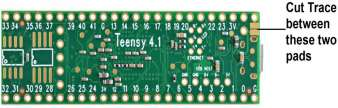
Important: Cut the trace on the Teensy!
There is a trace which must be sliced through in order to supply 5VDC to the Teensy from the Main Board. This is typically done via the USB connection. Since the radio is connected to USB only for programming, the 5VDC must come from the main board. Here is what the PJRC web page says:
VIN Pin When USB power is not used, 5V power may be applied to the VIN pin. Because VIN & VUSB are connected, power should not be applied to VIN while a USB cable is used, to prevent the possibility of power flowing back into your computer. Alternately, a pair of pads on the bottom side may be cut apart, to separate VUSB from VIN, allowing power to be safely applied while USB is in use.
Top Side Surface Mount Parts
This board doesn’t have a high density of surface mount parts. There is one integrated circuit, and a handful of capacitors, resistors, and ferrite beads. I have started using a hot plate to solder these parts. This goes quickly.
The four 3.5mm stereo jacks are surface mount and they are the last things to reflow. Keep an eye on them, and when they finally reflow, the top side reflow process is close to done.
There is a small marker to indicate Pin 1 on the IC. It is an SOIC package and it solders easily without shorting.
Headers for the Plug-in Devices
There are several headers for the Teensy and data converters. I insert the headers into the board with the board being held in a vise, and then put a small drop of “super glue” on each end of the header. This holds them in place when the board is flippped for soldering. All of the pins are carefully hand soldered, which is a time consuming process.
IDC Connectors
As mentioned above, be sure to get these on the correct side of the board and oriented correctly! Take it very slow, and make sure the connectors are flush to the board during the soldering process.
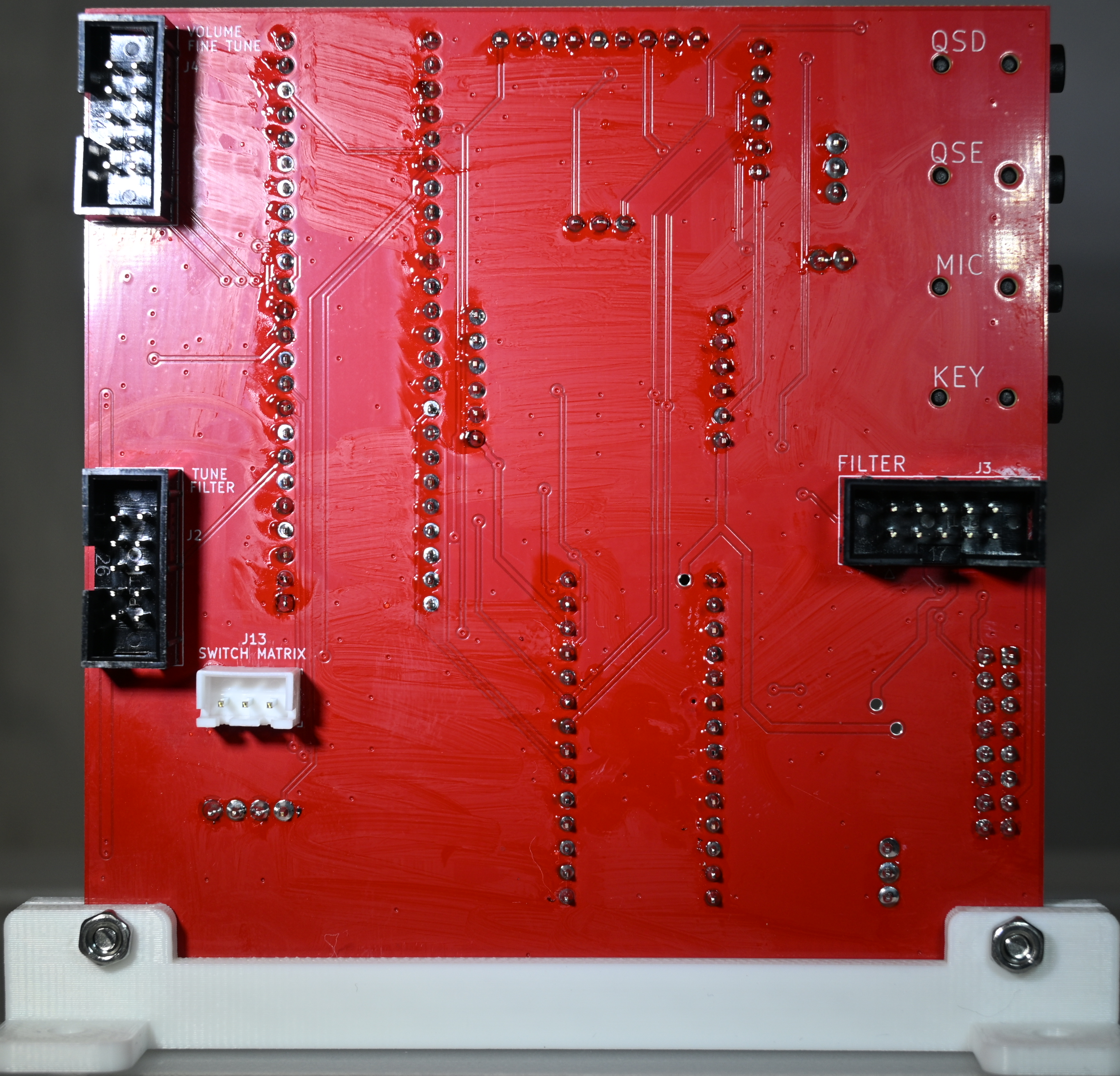
Note that only the 16 pin IDC connector is on the top side of the board. The three 10 pin connectors are on the bottom side.
JST Connectors
There are 2, 3, and 4 pin JST connectors. I like to use this type of connector, as they are polarized. Only the 3 pin Switch Matrix connector is inserted into the bottom side of the board. All others are mounted on the top side.
Header for Display Voltage Selection
The display voltage selection header is a regular style bare header with 3 pins. You will need to use a jumper to select the voltage which is used to supply the display. In the future, the optimum supply voltage will be selected, and this header and jumper will be eliminated. For now, I have been using the 3.3 volt jumper position.
Cable Assemblies
You will need to build several cables. This requires the small pins and a crimping device. The small pins come in a roll, and they are listed in the BOM. Here is a link to a crimper:
https://www.amazon.com/gp/product/B01N4L8QMW
The little cables are tedious to build. Proceed slowly and you will achieve a reliable result. These are “JST XH” style connectors. A list of the cables which need to be built:
- 4 pin XH to (audio amplifer connector) audio amplifier. This carries analog audio and amplifier enable signals.
- 3 pin XH to 3 pin XH from Main Board to Audio Adapter. This is for transmit I and Q. Don’t use a polarized connector on the Audio Adapter side, because it may need to be flipped if the sideband is wrong. Use a plain header on the Audio Adapter so that flipping is possible.
- 2 pin XH to 2 pin XH from Main Board to Audio Adapter. This is for microphone audio.
- 3 pin XH to 3 pin XH from bottom side of Main Board to Switch Matrix.
More on the Audio Adapter
The Audio Adapter information is here:
https://www.pjrc.com/store/teensy3_audio.html
For #2 above, the correct 3 pins on the Audio Adapter are marked on the bottom side! They are L G R which means “Left Ground Right”. Solder a regular non-polarized header into those 3 holes. For #3 above, the correct 2 pins on the Audio Adapter, also marked on the bottom side, are “MIC GND”. Note that the MIC output has a DC bias which is intended to power an electret microphone element.
High Resolution Photos of T41-3 Main Board
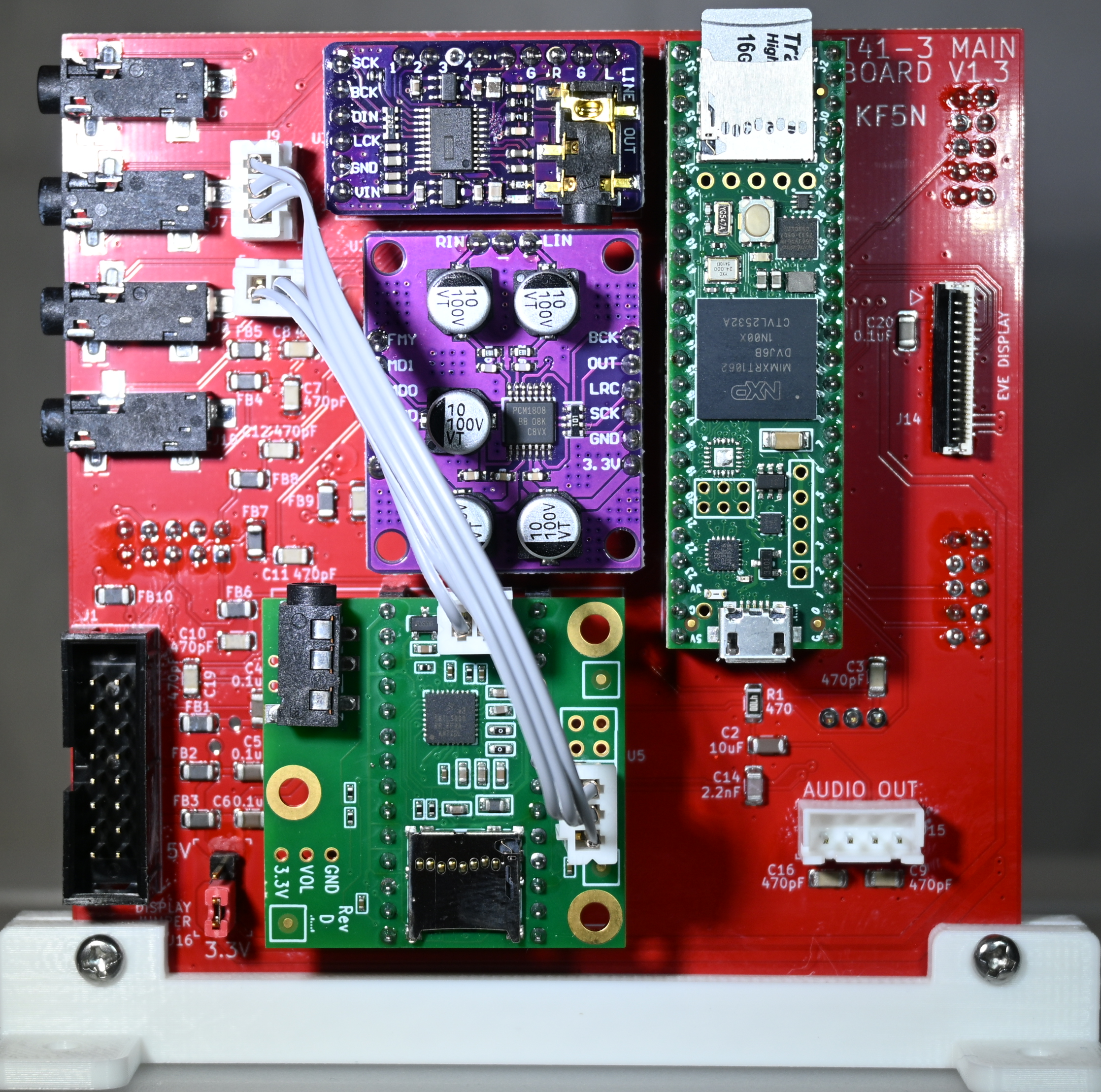
Links to photos of a fully constructed T41-3 Main Board follow. Click on the image for high-resolution photos.
PCB Symbols and Footprints
The libraries folder includes symbols and footprints. You will need these libraries:
https://github.com/Digi-Key/digikey-kicad-library
https://github.com/XenGi/teensy_library
https://github.com/XenGi/teensy.pretty
References and Further Reading
- “Digital Signal Processing and Software Defined Radio, Theory and Construction of the T41-EP Software Defined Transceiver”, by Albert F. Peter, AC8GY, and Dr. Jack Purdum, W8TEE. This is the ultimate resource for builders of the T41 Software Defined Transceiver: https://www.amazon.com/Digital-Signal-Processing-Software-Defined/dp/B0F5BDQZW3